Abstract
Our team participated in OPTIMA 2025 with three contributions spanning healthcare operations, observatory systems, and industrial maintenance. We presented a robust routing framework for home hospitalization with interdisciplinary teams under uncertainty, a decision oriented system relevance ranking for Paranal Observatory logs using an extended MULTIMOORA approach, and sensor based models to predict equipment degradation in wine bottling lines. Together these works illustrate our focus on combining operations research and machine learning to deliver practical improvements in operational performance.
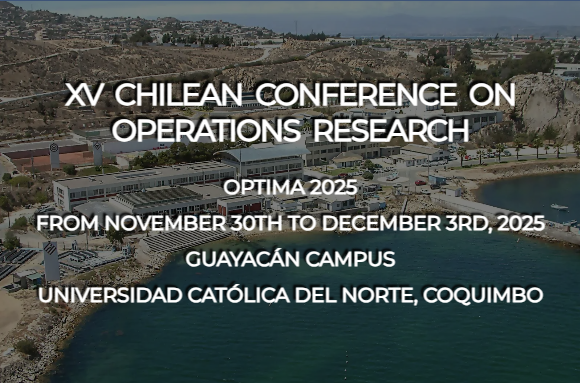
At OPTIMA 2025 (XV Chilean Conference on Operations Research), our group shared three contributions spanning healthcare operations, log analytics for observatory systems, and industrial maintenance.
-
Diego San Martín presented a robust routing framework for home hospitalization with interdisciplinary teams, addressing uncertainty in demand and travel times while balancing workload and service levels. This work is part of our FONDECYT project co-authored with Rodrigo A. Carrasco.
-
Andrés Catalán introduced a decision-oriented system relevance ranking for log analysis at ESO’s Paranal Observatory using an extended MULTIMOORA approach, supporting maintenance triage from high-volume operational logs. This work is part of our FONDECYT project with Rodrigo A. Carrasco and Gonzalo Ruz.
-
Alejandro Mac-Cawley presented a study on predicting equipment degradation in wine bottling lines from sensor data (with T. Stuck, R. Askenasy, R. Carrasco-Schmidt, M. Castro, A. Cho, R. Luna, and G. Ruz). This contribution is part of the PLASMA project in collaboration with Viña Concha y Toro.
Together, these talks underline our focus on applying rigorous operations research and data-driven methods to real-world challenges in health services, large-scale technical systems, and industrial operations—advancing the impact of our FONDECYT and PLASMA lines across domains.
Rodrigo A. Carrasco
Associate Professor & Director of Data and Computing
Alejandro Mac Cawley
Pontificia Universidad Católica de Chile

Andrés Catlán
Ph.D. Student, Industrial Engineering and Operations Research
Raúl Araneda
Ph.D. Student, Engineering and Sciences with the Industry